Gaza healthcare workers: Two women who refused to leave
26 March 2026

The women who survived this war had another woman standing behind them.
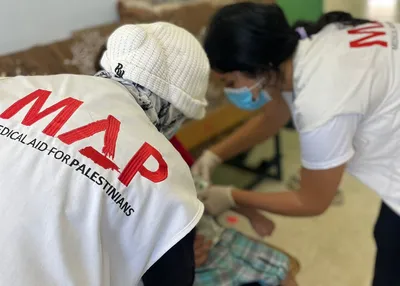
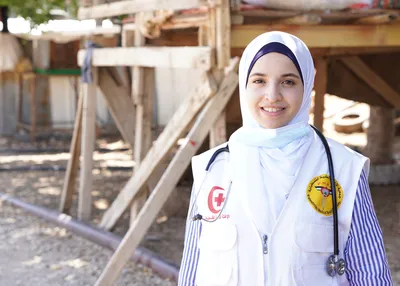
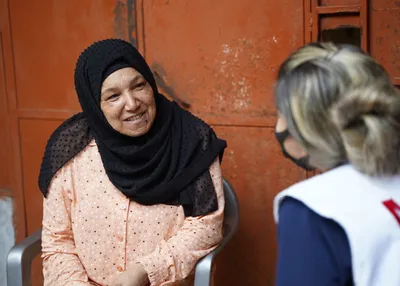
Abeer and Norhan work with Medical Aid for Palestinians (MAP) in Gaza City. As Israel's genocide systematically dismantled the healthcare system around them, both women helped build vital healthcare services from scratch.
When Palestinians were driven from their homes, both made the same decision: to stay as the invasion closed in around them.
Here, they share their stories.
Context: In December 2024, the Israeli military issued its sixth forced displacement order across Gaza City since October 2023, placing even greater strain on the already devastated healthcare system.
MAP supported the NICU, as well as sexual and reproductive healthcare services, at PFBS Hospital and Sahaba Medical Complex in response to the severe collapse of both services.
The decision to stay in Gaza City
Abeer had already lost her mother during the genocide. Her father's health had also been deteriorating, and when the forced displacement orders came, he refused to leave. With no access to his medication, which was only available in the south, he suffered a brain stroke and passed away.

When asked about her decision to stay, she reflects: “Perhaps I made this decision because we had already been completely exhausted. We went through extremely severe periods of starvation and experienced every form of fear, stress, terror, and deprivation.
“I felt that there was nothing left that we had not already endured. So I simply decided that I would not leave my home, that I would not leave Gaza City, and that I would continue working as much as I could until the very last moment.”
For Norhan, the decision was instinctive. She and her family, along with many of their neighbours in the old city, had consistently chosen to stay through each set of forced displacement orders. They had already lived through starvation, fear and direct attacks. An Israeli military airstrike on St. Porphyrius Church nearby had forced neighbours to go out and recover the victims themselves, as the dangerous conditions prevented civil defence and ambulances from reaching the area in time.

“My family and many of our neighbours agreed that we would not leave the area. This was not out of defiance, but because we did not know where we would go, and displacement was not even an option in our minds.
“Of course, we felt fear and anxiety, but fear was everywhere in Gaza. Despite everything, we were not psychologically ready to leave our homes or to be displaced. Therefore, we decided as neighbours and community members to remain together in the place where we lived.”
Working during the height of genocide
Both Abeer and Norhan witnessed firsthand what the destruction of healthcare meant for the people in their care. The scarcity of medical supplies, equipment and medication deepened with Israel’s deliberate denial of aid entry into Gaza. Hospitals were operating far beyond capacity, and the conditions driving demand continued to worsen.
Women struggled to receive care, which meant that the very idea of family was under threat.
Norhan describes what she witnessed: "Under the harsh conditions of war, we witnessed the extent of the health challenges women were facing, [and] observed a noticeable increase in premature births."
“Perhaps the most painful feeling [for the hospital teams] during those days was a sense of helplessness, the feeling of not being able to leave the hospital and abandon the patients.”
Working on neonatal care, an area she had a personal connection to having been born prematurely herself, Abeer saw what that collapse meant for the most vulnerable. At times, three to four premature babies were sharing a single incubator. “I know very well that these small babies had no one in those circumstances; they were born into unimaginable conditions”

“I remember the case of a premature baby who had lost his entire family. He was placed in one of the incubators. He came into life at a moment when the genocide had already taken everything from him, from the very first second. It was very difficult for us to witness such cases, but we always tried to hold on to the idea that we were doing our best to save this child’s life and to give him a chance, even with the limited resources and in the difficult conditions in which we were working.”
At the height of the genocide in Gaza city, obstetricians, midwives and doctors worked non-stop, some for two consecutive weeks. Training sessions on women's and newborn care continued, even as tanks closed in outside.
It is the local teams Abeer returns to: “We would not have been able to continue without the determination of the local medical teams, who insisted on staying even in the most difficult moments, when the army forced people to evacuate Gaza City, when forces were approaching the hospital, and when quadcopters were firing in the area.”
Reunited after the ceasefire announcement
With the office relocated south, both women worked from home, maintaining contact with each other, and MAP’s local partners at the hospital, across weak and frequently disrupted phone lines. Unable to meet in person, the knowledge that they were each going through the same thing was its own comfort.
When the ceasefire was finally announced in October, Abeer first went to her father's grave, where he had been buried in haste next to her mother. Immediately after, she called Norhan.

"The meeting carried a special sense of awe," Norhan says, "because it was our first time seeing each other after the death of her father and after all the heavy days and fear we had endured. We could not believe that we were standing in front of each other again after all that time. It was a moment filled with emotion, where grief and loss blended with a sense of survival and hope."
For Abeer, the moment similarly held everything that had come before it. "To meet after everything we had been through, to know that the war had stopped, and that despite everything we had not stopped working, and to see her standing in front of me at that moment. It was a major moment for me, one that I will remember for a long time."
“We as women support one another”
Reflecting on everything she endured, Abeer credits the women who stood by her: “I would not have been able to endure the war and everything I went through without the women in my life. From my mother, Wahiba, to my dear sister who never left my side, and my friends who stood with me during times when I was not even able to think clearly.
“I also believe that many of the women who survived this war had another woman standing behind them, pushing them forward. We as women support one another and flourish in each other’s presence.
"The women who faced unimaginable circumstances during the war were a true example and a source of inspiration for me. They strengthened me and many others like me to continue and to resist despite all the hardships."
Norhan looks forward.
"I hope there will be a real end to all the conditions that force women to live through such hardships, that the ongoing deterioration of medical care will come to an end, and that a genuine recovery phase for the health sector will begin."