How the US-Israel war in Iran is affecting Palestinians in the West Bank

Since the US and Israel’s war on Iran began, Palestinians in the occupied West Bank have faced severe restrictions on movement, intensifying deadly settler attacks, and major disruptions to healthcare.
We spoke with residents of communities served by MAP’s mobile clinics to understand how the recent regional escalation has affected their daily lives.
Who we spoke with*:
Zaher is a farmer from Al-Musaffah, a community in the Jordan Valley. He is married with six children. Before October 2023, he worked the land. Since then, restrictions on movement have cut off both people and supplies, leaving farmers like Zaher without the water and resources needed to work.
Dalal lives in Beita, a town of around 16,000 people south of Nablus. She is married with four children and works at the local municipality, placing her at the heart of a community that has long faced settler hostility with constant attacks, road blockages, and land seizures in the surrounding mountains.
Zeina is from Al Jiftlik, a village in the Jordan Valley hemmed in by checkpoints, where she works in a nursery and raises three daughters. Her home has been under the threat of demolition since October 2023; a consequence of living in Area C, where building permits for Palestinians are almost never granted, leaving homes in permanent legal jeopardy.
*Names have been changed to protect the identities of those involved.
"Movement has almost stopped"

The communities of Al-Musaffah, Al Jiftlik, and Beita sit across two of the West Bank's most vulnerable areas in the Jordan Valley and the area south of Nablus. Long subject to movement restrictions, checkpoint controls, and settler violence on their land, these communities have seen conditions rapidly deteriorate since the start of the war.
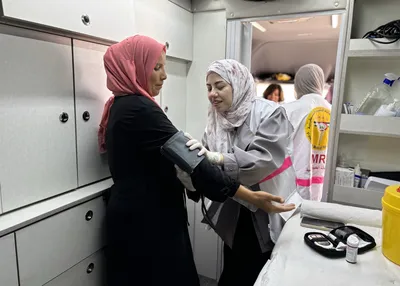
When the regional escalation began, road closures prevented MAP's mobile clinic from reaching these communities for an entire week.
In the Jordan Valley, checkpoints between Al-Musaffah and Al Jiftlik have nearly entirely blocked movement in and out, cutting off communities whose livelihoods depend on the land.
No schools, no health clinics. Jericho City was totally closed off. The checkpoints were closed. So how are we supposed to go out or come back?
Zaher
"Farmers are affected because they cannot deliver their agricultural goods," Zeina told us. "The region is agricultural, so this disrupts the economy."
In Beita, the impact has been felt differently but just as sharply. Before October 2023, many residents worked as labourers in Israel due to economic necessity, including the lack of employment opportunities in the West Bank.
Since then, the majority of Israeli work permits have been revoked for Palestinians, resulting in a severe economic crisis for communities who depend on this income. Despite local associations stepping in to distribute food vouchers and parcels to those in need, the rise in demand far outweighs capacity.
Dalal explains further: “Before, we had around 400 families registered as needing support through these associations. Now the number has doubled because of the crisis.”
Fuel and gas have become scarce across all three communities. "To get a gas cylinder you have to register your name and wait maybe a month or two for your turn," Dalal told us. "As soon as it arrives, it finishes immediately."
"The doctors cannot reach us"
For communities where labour income has collapsed due to restricted movement, the cost of medicines, however small, is simply out of reach. When the roads and checkpoints closed for a full week following the regional escalation, this reality hit immediately.
"The government health clinics in the area are totally closed, as the doctors cannot reach us," Zaher told us. "For almost 20 days they didn't reach us at all."
Even where local health centres were accessible, options remain severely limited. "We have an urgent care centre in Beita, but the town is very spread out geographically," Dalal explained. "The area where the mobile clinic serves is far away from the urgent care centre so people in that area might be with no healthcare services in such situations."

In Al Jiftlik, Zeina described a similar picture: "If someone needs a doctor, they must wait hours or try to travel to Nablus." However travelling anywhere, including Nablus, was in of itself near impossible. “For example, there was a pregnant woman who needed urgent care. She went back and forth to the checkpoint but wasn’t allowed to cross, leaving her unable to reach her doctor for two days.”
For those who managed to source medicines elsewhere, the cost remains a serious burden. "There are children, pregnant women, and people with chronic diseases who cannot go out to get medicine themselves or cannot afford it," Dalal told us. "We have children with diabetes and children with disabilities whose medicines cost between 1,200 and 1,400 shekels [approximately £288-336] per month. Many families cannot afford them."
"People try to support each other, but in the end the options are limited if the roads remain closed."
“The settlers have been very aggressive.”
Since the start of 2026, settlers have killed at least seven Palestinians in the West Bank, nearly matching the total number killed throughout all of 2025.
“The situation has definitely changed since the war on Iran, especially in these past two weeks. Young men from the town go up to the mountains to watch and alert others so that vehicles can move safely, because settlers sometimes block the roads or attack people."
Just two days ago, settlers attacked that area and assaulted people heavily. Yesterday, a young man had his arm broken when settlers attacked the youth of the town.
Dalal
Dalal's description of life in Beita captures something felt across all three communities. Since the outbreak of the war on Iran, settler attacks have intensified; targeting their homes, farmland and public spaces. This violence has seeped into every corner of daily life in these communities, with the children being particularly affected.
She gives us another example of a family she knows, who experience frequent harassment from settlers: “Their son is about nine or ten years old. Once, they held him for half an hour or an hour. Since that happened, the boy refuses to go to school or even leave the house without his mother.
“The boy is traumatised. He refuses to go anywhere, even to the town hall where he used to go. He doesn’t want to leave the house anymore.”
Zeina echoes this heightened fear within her community: “Children are afraid. Settlers harass and intimidate them. Life has completely changed. Parents are preventing children from leaving home unaccompanied out of fear from Israeli settler attacks.”

In Al-Musaffah, settlers have moved against the community's oldest spaces. "We have an old cemetery in the town, about 150 to 170 years old," Zaher told us. "Recently Israeli forces practically took it from us completely. Only a very small part is left for us to bury our dead." The cemetery has since been classified as government land; one of several legal mechanisms used to transfer Palestinian land to Israeli control.
Beneath it all runs a deeper fear, not just of violence, but of losing their homes entirely. "The biggest fear is demolition," says Zaher. "There isn't a week or 20 days that pass without demolitions." In Al Jiftlik, Zeina's own home has been under threat of demolition since Israel’s genocide in Gaza began. "You live every day feeling like they could come at any moment and force you out."
Both Al-Musaffah and Al-Jiftlik sit within Area C, which covers more than 60% of the West Bank and remains under full Israeli military and civil control. Building permits for Palestinians in this area are almost impossible to obtain, and without one, any structure is vulnerable to demolition.
In the first nine months of 2025 alone, Israeli authorities demolished 1,288 Palestinian structures in the occupied West Bank, including East Jerusalem, due to lack of permits; a 39% increase compared to the same period in 2024.
"We are attached to this land"
Zaher, Zeina, and Dalal have faced road closures, settler violence, and demolitions. Yet they speak not just for themselves but for their entire communities when they say: this is their land, and they are staying.
"Of course there is fear," Zaher told us. "But where would we go? We are attached to this land. Even if houses are demolished, people stay. They don't leave their land."
In Beita, that determination has taken on a collective dimension. When settlers target a specific house, the community rallies around it. Dalal explained: "People from the town come and stay with that family to protect them. Sometimes the wife and children move temporarily to another place in the town while young men stay in the house to guard it." No one, she is clear, has left their home completely.
People are determined to stay. Families want to remain in their homes and on their land.
Zeina
For many Palestinians across the West Bank however, staying is no longer a choice. Since the start of 2026 alone, demolitions and settler attacks have displaced more than 1,500 people from 29 communities; 600 of them from a single Jordan Valley herding community similar to Zaher's, forced out after months of sustained settler harassment.
Across these communities, people continue to hold on to their homes, their land and their routines where they can. With ongoing restrictions and escalating violence, what this looks like changes day by day. Even so, communities continue to adapt. Supporting one another, sharing what they have, and finding ways to endure.
Related content