Life without water in Gaza: Testimonies from MAP aid workers
30 September 2026

People are not asking for luxury. They simply want clean water, a toilet, basic hygiene supplies, and a safe place where their children can sleep with dignity.
Ahmad, MAP water agent
Since the start of the ongoing genocide in Gaza, Israeli forces have destroyed vital infrastructure and forcibly displaced around 90% of the population, leaving thousands of families without reliable access to safe water.
Without a regular supply of safe water, disease and infection spread rapidly through the tents and other temporary shelters that displaced Palestinians are living in, exacerbating an already critical health emergency.
Health infrastructure lies in ruins, sanitation systems have all but collapsed, and families displaced again and again are left to depend almost entirely on humanitarian water trucking to drink, cook and wash.
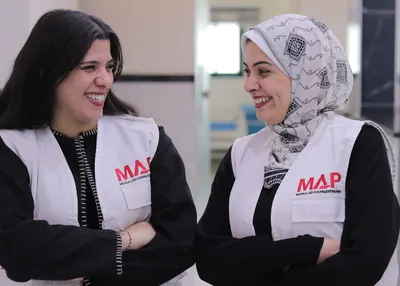
MAP's teams are among those working to make sure families can access clean water. Here, two of our colleagues describe what that work looks like.
Ahmad Matar, MAP Water Agent in Gaza
"My name is Ahmad Matar, and I work as a Water Agent within the Public Health team at MAP.
"I have been working daily to support water distribution services for displaced families across Gaza. I am originally from northern Gaza, and I remained there throughout the genocide, witnessing firsthand how access to water has become a matter of survival rather than a basic service."
The UN’s Office for the Coordination of Humanitarian Affairs (OCHA) reported that by late March 2026, average water availability across Gaza had fallen to just 4.5 to 6 litres per person per day, well under half of the 15-litre daily minimum WHO sets even for the acute phase of a humanitarian emergency.
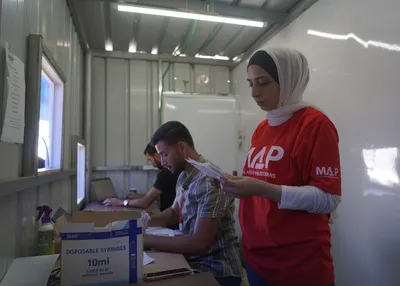
"My main role is to monitor and follow up on water distribution to displaced communities, making sure the water we provide reaches families in need and is safe for use. Altogether, our services reach around 87,000 people every single day, families who depend almost entirely on the water we provide for drinking and daily use.
"The collapse of sanitation services has led to the widespread presence of insects, rats, and other pests throughout the camps. This is something we witness regularly.
"During a visit to Al Mawasi [west of Khan Younis], we came across the case of an infant who had been attacked by a rat inside the family's tent during the night. The baby was only around five months old."
"As a field worker, it is incredibly difficult to witness these realities every day. I try never to lose my sense of humanity or become numb to what people are living through.
"Every time I enter a camp, I remind myself that ensuring people receive water safely and with dignity is, above all, a human responsibility. For me, the arrival of a water truck does not simply mean water delivery. It means reducing disease and preserving dignity.
"Unfortunately, despite the ceasefire, the humanitarian reality on the ground remains devastating. The danger has not disappeared, essential services are still close to collapse, and families continue sinking deeper into hardship every day."
We will remain in the field, among people, serving them.
Ahmad Matar, MAP Water Agent in Gaza

Sulaiman Qasem, MAP Emergency Programme Officer in Gaza
The baby Ahmed met in Al Mawasi camp is just one example of a much wider crisis facing families across Gaza's displacement camps.
Our life has become a nightmare. My two children are covered in flea bites and they cry all night. Their mother and I have tried almost everything, but we cannot control the situation or find a solution.
Father of two, 29, displaced in Khan Younis
Sulaiman Qasem, MAP's Emergency Programme Officer, describes the conditions behind the crisis, and the scale of the risk for families in camps.
"The accumulation of rubble across Gaza has created ideal breeding grounds for rodents, compounded by the continued presence of bodies trapped beneath the debris, mounting waste, and the near total destruction of sewage and sanitation systems.
"Families are being forced to live in overcrowded displacement camps and makeshift shelters that are not even suitable for human habitation. These areas lack even the most basic sanitation infrastructure. In such conditions, rats have proliferated rapidly."
Rats are eating our food. We can barely get enough to eat, and we cannot even store it because rats reach it immediately.
A 16-year-old, displaced in Khan Younis
Sulaiman continues, "The public health implications are severe. Rats are carriers of dangerous diseases such as rat bite fever and potentially plague, not to mention their carrying of lice and transmission of harmful fungi and bacteria.
"This raises serious concerns about the spread of diseases and infections, further complicating the situation, particularly given the deteriorating health system and the lack of basic materials and tools to combat such widespread infectious diseases.
"The rights to health, to safe living conditions, and to a clean environment are not optional; they are essential. When people are denied even the most basic means to protect themselves from these dangers; it becomes a direct breach of those rights."
A true and meaningful action to end the continued suffering of Palestinians is needed more than ever.
Sulaiman Qasem, MAP's Emergency Programme Officer in Gaza
Related content