Play and Heal: "Allowing children to be children again"
4 September 2026

These classrooms were built for children to learn and dream. Today, they are crowded with families carrying fear and uncertainty. When the session begins, the school sounds right again. For a short time.
Parent of a child attending MAP's mental health project activities in a collective shelter during the recent hostilities on Lebanon.
Months of hostilities, forced displacement orders issued by the Israeli military and armed clashes have left communities across Lebanon in a near-constant state of upheaval.
Families who had already been displaced from their homes, have been forced to move again. Temporary shelters have become long-term homes, and Palestinian refugee camps face persistent risks of overcrowding and service gaps.
Since 2 March, at least 4,346 people in Lebanon have been killed by the Israeli military, including 366 since the ceasefire announcement on 20 June 2026. Of those displaced, over 823,000 people have been able to return to their homes, but more than 334,353 remain displaced.
Behind these numbers are children who have spent months absorbing fear, disruption and uncertainty, with little space to process what they’re feeling, or even have the words to describe it. School has been interrupted, children are growing quieter, and for many, even the desire to play has faded.
For Palestinian children, the repercussions of the conflict have worsened restrictions they have already lived with, including access to healthcare and education, stability in daily life, and free, safe spaces to play.
My daughter was full of life, she was so quiet after we left our home, she stopped playing. Through the sessions, she slowly started talking again, playing, and interacting with other children again.
Parent of a child attending MAP's mental health project activities in a collective shelter during the recent hostilities on Lebanon.
As part of our mental health and psychosocial support work in Lebanon, Medical Aid for Palestinians (MAP) works with partners to run play-based activities for children and their caregivers, shaped around what they want and need. We coordinate with several partners to support the delivery of these activities across nine Palestinian refugee camps in Lebanon.

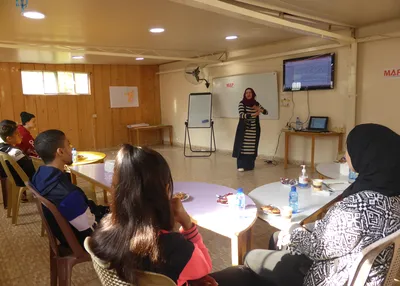
For a few hours a week, Play and Heal sessions are held across several collective shelters and community centres to give Palestinian children a safe space to be children again – something continuous conflict in the region has taken away from so many of them.
Through structured play-based activities, children are supported to rebuild confidence, strengthen their coping skills, and restore a sense of wellbeing, belonging and connection with others.
Ahmed’s story with Play and Heal
Ahmed first joined the Play and Heal sessions following, and during, the recent escalation in Lebanon. While his own family was not displaced, the impact of the conflict affected many in the community through ongoing instability and safety concerns, particularly in refugee camps where overcrowding puts additional strain on already limited resources.
It's within this environment that children like Ahmed are growing up, carrying stress and uncertainty they don't yet have words for. Worried not only for themselves, but for the people they love as well.
When Ahmed* first joined the sessions, he was a quiet and reserved child who rarely spoke in group settings. Although he often knew the answers during activities, he lacked the confidence to share them, choosing instead to silently observe from a distance. He found interacting with other children difficult, and putting words to his feelings even harder.
By the fifth session, something had changed.
Ahmed's mother reached out to the programme facilitator to share what she'd noticed at home. For the first time, she saw Ahmed actively building friendships. He was talking to more people around him, and becoming increasingly comfortable expressing himself. He was also able to manage his stress much better, and even started giving names to the feelings he had been silently carrying for so long.
Facilitators saw the same shift on their side. Ahmed, who initially only ever attended alone, started arriving with other children. He began taking part in discussions instead of watching from the sidelines, growing more confident in a larger group.
Through sessions that explored personal boundaries and self-understanding, he learned to recognise what he needed and, just as importantly, felt able to ask for it.

This is exactly why Play and Heal exists.
Ahmed's story may be a small one. A child who went from quietly watching the sessions alone at the edge of the room, to eagerly arriving with his friends, ready to fully participate. But this is what these sessions are built for; not a single dramatic turnaround, but a child slowly finding his way back to himself, in a time that asked too much of him.
*Names have been changed to protect the identity of people involved.
About Play and Heal
UNICEF first introduced the Play and Heal methodology in Lebanon after the war in 2024, to support children who had lost access to normal activities and routines. It provided a space where they could play, express their emotions, learn and interact with each other in a safe environment.
MAP works with eight local partners across in Lebanon to implement specialised child and caregiver-centred psychosocial support activities. The Play and Heal sessions use cooperative games, storytelling, movement, and creative activities to help children rebuild what war interrupts.
The team delivering the sessions were living through the same uncertainty as the families they support; navigating the same disruption, the same fear, often with as little stability in their own lives.
Through it all, they keep these sessions running, giving children one of the few steady points in their week.
Even though life is still uncertain [during the current ceasefire], attending these sessions reminds my child that it's okay to play, laugh, and be a child again.
Parent of a child attending MAP's mental health project activities in a collective shelter during the recent hostilities on Lebanon.


Related content