Israel's genocide in Gaza: Yaqoub's long road to recovery
8 October 2026

On 6 May 2025, an Israeli military airstrike destroyed the Shehab family home in Khan Younis. Hisham Shehab; a pharmacist, father, and widely loved community figure, was killed alongside his wife, Nermeen, and their three-month-old baby.
Their two young sons, Yaqoub, now six-years-old, and Murad, now eight, were the only survivors.
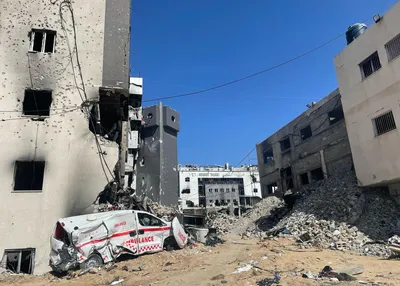
Hisham is one of more than 1,700 healthcare workers killed during Israel’s genocide in Gaza since October 2023. More than 300 Palestinian healthcare workers in Gaza have been detained by Israeli forces over the last three years, and countless hospitals, clinics and health centres have been destroyed.
Losing everything familiar
Yaqoub was pulled from the rubble with third degree burns across his body, complex fractures, head trauma and damage to his feet that surgeons initially thought should be amputated. Murad, too, had complex fractures requiring specialist treatment.
Over a year later, the children still don't fully understand what happened to their family.
“What Yaqoub has endured is unimaginable," Abeer, Yaqoub and Murad's aunt, told us. "His pain after the surgeries, the severe burns on his legs, the constant crying despite strong painkillers, nothing helped. He cried day and night especially during wound dressings. Those sounds are still in my memory. I can never forget them.”
Their pain is even deeper because they lost both their parents. Every child, when sick or in pain, looks for their mother. Without that sense of safety, how can a child cope?
Abeer, Yaqoub and Murad's aunt
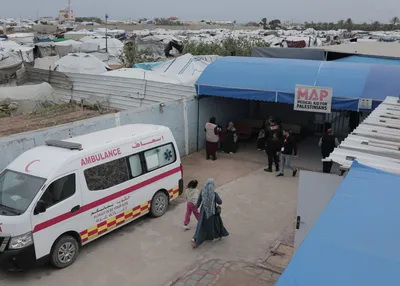
After 15 painful surgeries, Yaqoub received rehabilitation at MAP’s Solidarity Polyclinic. When he first arrived, it was evident that he showed signs of trauma, as well as his physical injuries. The clinic has since played a critical role in his recovery, providing physiotherapy, wound care and psychosocial support.
“Before each dressing session, Yaqoub would come to the psychosocial support space," Hannan, MAP’s Psychosocial Support Facilitator told us. "Over time, we noticed that he began to feel comfortable at the clinic. He felt safe there. He was surrounded by people who cared about him and genuinely wanted him to get better. Gradually, his screams faded.”

With limited resources due to the systematic dismantling of Gaza health system and Israel's ongoing siege, staff at the clinic did what they could – but Yaqoub and his brother Murad required far more complex care than is available in Gaza. Due to Israel's discriminatory permit regime on Gaza, they remained trapped without treatment for months.
In order to leave Gaza, including to seek urgent medical care, Palestinians must apply to Israeli authorities for permission to travel, and there’s no guarantee of a response. Permits can be delayed, denied, or simply left unanswered until the hospital appointment has passed. Over 18,000 patients urgently need medical treatment that is not available in Gaza.
According to the Palestinian Ministry of Health, more than 1,400 people have died while waiting for medical evacuation, and at the current rate, it would take four years to evacuate everyone still on the list.
As healthcare workers, what weighs on us is not only the scale of the injuries, but also the awareness that, despite all our efforts, we may not be able to help everyone reach full recovery. Even so, we hold firmly to one principle: leave no one behind.
Sobhi, Rehabilitation Point Coordinator at MAP’s Polyclinic.
Recovery during displacement
Like the majority of Palestinians in Gaza, Yaqoub and his family had been displaced, interrupting his treatment and recovery. After his home was destroyed, Yaqoub lived with his aunt in a tent. An entirely unfit environment to support his rehabilitation.
Winter floods soaked their belongings; sandstorms filled the tent with dust; and extreme heat and humidity made summer unbearable. The Israeli military’s destruction of life-sustaining systems, including water, sanitation and hygiene infrastructure, created an environment rife for infestations of insects, fleas, and rats – each risking his recovery.
Amid Israel’s siege, Yaqoub’s family struggled to find adequate food and water, and medication he needed for recovery. What they could find couldn’t be stored without electricity, leaving his medication and food to spoil.
“We [were] not just dealing with a complex injury, but with a combination of factors that have deeply affected the course of treatment," MAP Physiotherapist, Khalil, told us. "Physiotherapy alone is not enough in such cases, especially for a child with complex fractures who is also dealing with malnutrition. There was a lack of basic food, protein, and nutritional supplements, which directly impacted the healing process.”

By December 2025, Yaqoub and his brother Murad had secured treatment at an Italian medical facility, but each time his family applied for permission to accompany them, Israeli authorities rejected the requests. It wasn't until April 2026 that Yaqoub was finally able to leave Gaza for treatment in Egypt, accompanied by Murad and their grandfather, Sobhi Shehab.
"They need family as much as treatment"
Despite everything, Yaqoub has gradually improved, but this is not the end of his journey.
Yaqoub and Murad have experienced life-changing injuries, limiting their ability to move freely, walk long distances, or enjoy the universal childhood experience of playing with their friends. And like thousands of children in Gaza, Yaqoub and Murad are still processing the profound trauma of losing their family and their home.
"The children are now, to some extent, able to move around without their crutches, and I am happy to see them making this progress," Abeer tells us. "But they have been through so much, and they still need a lot of care and support.
"I wish I could be with them and take care of them, rather than having them displaced again and living far away from the family me and their grandmother tried to make."
I know it is going to be a long and challenging journey, but I dream of seeing them grow up and getting the treatment they need. I dream of seeing them reunited [with us].
Abeer, Yaqoub and Murad's aunt
Israel’s genocide in Gaza, marked by indiscriminate bombardment of civilians and civilian infrastructure, the use of collective punishment and starvation as a weapon of war, and the systematic destruction of the healthcare system, has had a profound and devastating impact on Palestinians in Gaza. Yaqoub’s story is one of many.
Palestinians, like everyone, deserve to live in safety and with their rights to health and dignity. But this demands real pressure from the international community, including the UK Government, to bring Israel’s genocide to a permanent end, allow unimpeded aid in so healthcare can recover, and hold those responsible for war crimes and crimes against humanity to account.