“My entire life is filled with stories of displacement and uprooting” – 78 years of ongoing Nakba
15 May 2026

This year marks 78 years on from the Nakba, a reminder that the catastrophe never ended. Israeli military violence, forced displacement, and trauma have shaped the lives of Palestinians across generations.
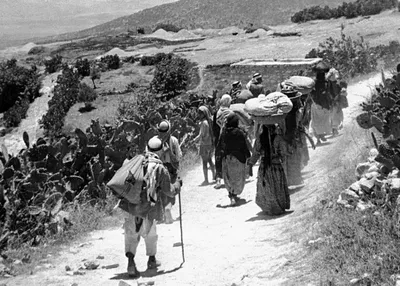
In 1947-48, at least 750,000 Palestinians were forced from their homes by militias as the state of Israel was established on the land of historic Palestine. Hundreds of villages were destroyed and families torn apart. The right of return for these families continues to be denied to this day, despite being enshrined in international law.
Today, six million Palestinian refugees remain registered with UNRWA. Most have never seen the homes their families were forced to leave.
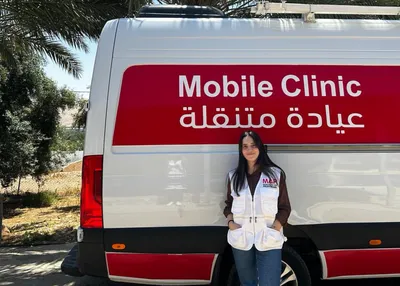
In the coming weeks, MAP staff working across Gaza, the occupied West Bank, Lebanon, and the UK share what it means to carry this catastrophe, not only as legacy, but as lived reality.
We begin in Gaza, with Mona.
My roots
I am originally a Palestinian refugee from the depopulated village of Barbara near Gaza.
Everything I know about Barbara comes from my family and from the stories they carried with them after Nakba. It was an agricultural village, famous for its grapes. Because of that, I was never surprised by my deep connection to nature and the land. I feel this is something rooted in us, like inherited genes, an extension of everything our family lived there.
After the Nakba, my grandfather and the family were first displaced to Khan Younis and later settled in Beit Lahia in north Gaza. I was born there and it was there that I first came to know life and the idea of a homeland. My family remained closely tied to the land. My grandfather and extended family continued farming even after arriving in Gaza, not as a source of income but as something inherited, part of their identity.

The person who influenced me most was my uncle Shaban. He was an elderly man born in the same year as the Nakba. His mother, my grandmother, gave birth to him under a tree while they were displaced. He carried the Nakba in his voice, in his features and in every detail of him.
He would gather us children around him and tell us about the land, the beauty of life and family, and the houses. He was a remarkable storyteller and he embodied the Nakba completely. Yet despite everything he experienced he remained full of kindness and love for life and people.
From my mother’s side there were also stories of displacement and loss. My grandmother had to lead the family alone after Israel’s occupation forced her husband into Egypt. My mother grew up without knowing or seeing her father in her childhood and only met him many years later.
My entire life, from both my mother’s and father’s sides, is filled with stories of displacement and uprooting, as if a Palestinian is born carrying the memory of a place they never fully saw but which lives within them.
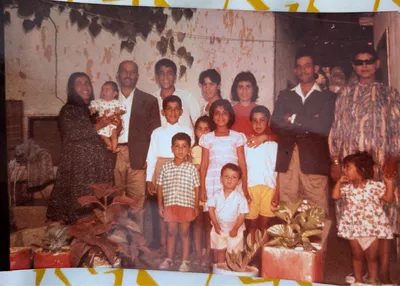
Before the war [in October 2023], I lived in Beit Lahia. Our house had several floors where the whole family lived, my uncles and their children. The entire neighborhood felt like one family. We also had a beautiful piece of land with pomegranates, apricots, guavas, grapes, lemons, but most of all olives. I used to play there from childhood with my brother Mahmoud. Even today, when I recall those images, I feel that my entire childhood was connected to the land.
Today, after what we have lived through in the genocide and displacement, I feel that the stories my family used to tell us are no longer just narratives of the past. They have become our present reality, perhaps in a more brutal and harsh form. My uncle Shaban passed away a few years before the genocide. And sometimes, I feel a painful sense of relief that he did not live to see what we have lived through.
My loss
Every morning, when I look at my face in the mirror, I think of my brother Mohammed. My features resemble his so much, as if his presence is still reflected in my face.

At the beginning of the war, we refused to leave Beit Lahia. My father was elderly and had a disability that made movement very difficult, yet our decision was to remain. But the situation became unbearable. The Israeli army threw gas at us and we suffocated inside the house. Only then, in October 2023, did we decide to leave to the south.
That day was one of the hardest days of my life. Thousands of people were being displaced from the north to the south in a scene that cannot be described. Fear surrounded us from every direction, especially after we learned that Israeli forces had bombed some people on the road. We were moving in terror.
But we could not bear staying away from Beit Lahia. After just one week, my father and I returned to the north. The Beit Lahia we returned to was not the place we had left. It was literally hell. From my bedroom window, I could see columns of fire around the Indonesian Hospital. In the final days, I began to hear tanks approaching more and more. At that point, my fear reached a level I could no longer endure.
Food began to disappear quickly. We started bringing very small amounts and rationing every bite, trying to stretch the food for as long as possible. Every detail of life turned into nothing but a struggle for survival.
After 20 days, I decided to leave again. My brother said to me: “Leave here and check the road, and me and dad will follow you.” The next morning, I left quickly. My father was asleep at that moment, and in our rush to reach what was called the safe passage, I could not even say goodbye to them. That moment still haunts me, that I left without knowing it would have been the final goodbye.
When we reached the Netzarim area, everyone suddenly stopped. We saw four sniper soldiers on the side of the road, and there was a tank only a few metres away from us. They ordered us to raise our hands, and I was holding my ID in my hand so I lifted it while trembling. The artillery in front of the crowd began firing at the ground and the road. There were no verbal instructions, no words at all. The bullets were the only language.
After a while, the tank moved, and people understood that this meant we had to walk. My uncle kept repeating to me, “Don’t look around Mona, just don’t look around.” He was afraid I would see something that would hurt me even more than I already was.
But the scenes I saw on the road will stay with me for my entire life. The car that was bombed on the road between the north and the south. Bullet marks on it, and traces of blood that remained on the ground around it. A few metres away, I saw the body of a child, maybe around 15-years-old. It was clear that the body had been burned. I passed right beside him. I had to keep going no matter what I saw.
I felt we had lost everything at once. The past was no longer intact, the present had already been shattered, and even the future seemed to be collapsing before our eyes. All I wanted in that moment was for the road to end, to get out of that place by any means possible.
When I arrived in the south, I completely broke down. I spent days not wanting to speak to anyone or see anyone. I was just trying to process what we had gone through. I just felt my mind was still stuck there, on the road.
We stayed only a few days before we were displaced again under fire. Somehow, miraculously, we managed to speak to my father briefly while we were packing our belongings. That was the last call with my father.
My brother Mohammed, a dedicated laboratory doctor who continued volunteering through the war, was killed along with my father on the night of 4 December 2023, one of the hardest nights for the north. They had been injured the day before from a nearby strike, returned home, and were killed there. Our friends buried them more than a month later, after the army withdrew, quickly and under fear.
I returned to my area a year later during people’s return to the north. We relied on a friend to guide us to our home because there were no landmarks left in our area. When we reached the beginning of the street, Mahmoud told me, “This is our house, Mona,” and I did not believe him. I could not figure out where it was until I realised as I was walking, and I collapsed.

My Nakba
As long as I still hear drones flying over my head, as long as I can’t really feel the sea, as long as I still see tents and rubble everywhere, and the smell of war is still there, the fire hasn’t ceased, and the Nakba is repeated every day. Our return feels like a dream, whether it’s where I was born, or where my origins are.
My name is Mona Ramadan. I’m a refugee, a daughter of refugees who are also children of refugees, and my children will most likely be refugees, as if misery passes through genes.
Related content