The cost of settler violence in the occupied West Bank "when there is no accountability"
21 August 2026

Settler violence in the occupied West Bank has skyrocketed in 2026, with the UN’s Office for the Coordination of Humanitarian Affairs (OCHA) documenting over 870 settler attacks resulting in casualties or property damage across more than 220 communities.
76 Palestinians have been killed by Israeli forces or settlers this year, including 18 children. Nearly 3,800 Palestinians, almost half of them children, have been driven from their homes due to settler violence, demolitions and evictions. Much of the displacement happened in the presence of Israeli forces.
Last month, armed Israeli settlers raided the village of Tel, near Nablus in the northern West Bank, where residents confronted them after they entered the community. The violence that followed left four Palestinians and two Israelis dead. Israel’s Prime Minister then ordered a “wide-scale military operation” across the West Bank, further enabling attacks by Israeli soldiers and settlers on Palestinian communities.
Israeli settler violence has escalated to include the siege of Palestinian homes across the West Bank, as well as the deliberate damage to water pipelines, electricity cables, generators and access roads. These acts restrict families’ ability to remain safely in their communities and deepen the risk of forcible transfer.
The consequences of Israeli settler and military violence extend directly into access to healthcare. Villages and towns with little to no healthcare facilities of their own have been sealed off, with checkpoints and iron gates closed for hours to days at a time. Ambulances are being delayed, turned back, or outright attacked.
The events of the past month are not an anomaly. They are the sharpest point yet in a pattern that has been building for months.
Medical Aid for Palestinians (MAP) spoke to communities and healthcare workers directly impacted by this surging violence.
Homes, land, and livelihoods destroyed
Across the villages and towns surrounding Nablus, residents describe a pattern that has become all too familiar: settlers attacking their communities with the direct protection of the Israeli military, land and property destroyed, and the lingering fear and uncertainty of what comes next.
Hani Nassar watched settlers bring in bulldozers into his village, Madama, days after the settler raid in Tel. He watched as the settlers tore an entire hillside of olive groves down; trees that had been part of their landscape for generations, each from 70 to 100 years old, as Israeli soldiers stood idly by.
"What is especially alarming is that settlers carried out this destruction under the protection of the Israeli forces" he told us. "Over the past few days, the settlers and the army have been operating together, restricting movement and preventing residents from leaving the village."
There is a growing feeling of hopelessness, as residents no longer believe anyone will protect them. Many now feel they have nothing left to lose except their homes.
Hani Nassar

In the village of Jit, residents live under constant violence and restrictions, with their only entrance controlled by a temporary checkpoint.
"The settlers' harassment never stops, they come during the day and at night," the head of Jit's village council, Jamal Yameen, tells us. "This is not something that happens occasionally; it has become part of their daily policy. In recent months, the level of provocation and violence has escalated significantly."
With little to no reliable access to healthcare, volunteers from the village received first aid training from MAP. Residents have also stationed firefighting equipment around the village, "because we know attacks can happen at any moment, and official emergency services may not be able to reach us in time."
In Ras al-Ain, settlers blocked the road to three family homes, established a tent outside the properties, and cut water and electricity supplies, trapping around 15 people, including children, inside. Israeli forces later ordered residents out of two homes and took up positions in Youssef Hassan’s house, effectively converting the purported “protection” response into a further loss of Palestinian control over the family’s property.
"My four-year-old keeps asking me why we left the house, where we are going, and why we cannot move around, when are we going back to our home," Youssef tells us. "She was preparing to start kindergarten, but if this situation continues, she may not be able to go.
"Healthcare has also become difficult. We were only able to get medication through coordination with UNICEF. Everything requires coordination."
At this rate, I would say that soon even the air we breathe might require coordination for us to access.
Youssef Hassan
A similar pattern was reported in the neighbouring village, Jalud, where the al-Tubasi family were reportedly driven from their home following a months-long siege in which water and electricity were cut off.
These incidents aren't happening in a vacuum.
The same system that makes even medicine deliveries dependent on the permission of Israeli authorities governs movement across the entire region. There are now around 1,000 checkpoints, gates, and roadblocks across the occupied West Bank including East Jerusalem. Each one of these obstacles is a point at which access to a hospital, a clinic, or an ambulance can be delayed, denied, or cut off entirely.
Checkpoint delays are costing lives
In the town of Sinjil, residents are living under a near-total siege. Four of the town's five entrances are permanently closed; with the fifth opening and closing at the discretion of Israeli authorities. Last month, it was closed for nine consecutive days.

Life in Sinjil has become like living in a large open-air prison. There is no security, no safety, and no normal life.
Mayor of Sinjil, Dr Motaz Tafsha
It was during this closure that Sujood, a resident of the town, went into cardiac arrest. After coordinating with Israel's Civil Liaison Office, a regional administrative branch of the Israeli military, the ambulance waited at the closed gate for roughly 15 minutes before Israeli soldiers arrived to open it, around 30 minutes after the request was first made.
"In a suspected heart attack, every minute matters." Dr Motaz tells us. By the time the gate opened, Sujood had already begun losing her pulse. She was pronounced dead shortly after arriving at hospital, despite the medical team's efforts to resuscitate her.
In the village of Qaryout, a pregnant patient, under close monitoring by nurse Sabrin Omar Muhsen, went into labour and delivered her premature baby inside the ambulance.
Israeli soldiers stopped the vehicle at the Awarta checkpoint, pointed their weapons at the healthcare workers, ordered the engine to be switched off, and held them for around 30 minutes. All onboard medical equipment had to be turned off during this time.
By the time the ambulance was allowed to continue, the baby had died. The mother reached Nablus’ Rafidia Hospital and was stabilised, despite significant blood loss.
No healthcare worker should ever have to choose between protecting a patient's life and navigating armed checkpoints while trying to provide emergency medical care.
Nurse Sabrin Omar Muhse
The World Health Organisation (WHO) has tracked a steady rise of attacks on healthcare in the occupied West Bank, including East Jerusalem, with 987 from October 2023 to 31 May 2026 resulting in 39 deaths, 201 injuries and affecting 673 ambulances. Since, these numbers continue to rise at an alarming rate, with 37 recorded attacks in July alone.
This year, over 93% of the 98 recorded attacks involved obstructed access, including: checkpoint delays, searches, harassment of medical staff, and restrictions on ambulance movement.
Attacks on hospitals and healthcare workers

Hospitals in the occupied West Bank have also seen the consequences of this surge in settler violence.
"The Israeli army raided the hospital’s emergency department following the incident in the village of Tel," Nablus Specialised Hospital Director, Ghassan Barakat, tells us. "The hospital received the bodies of three killed Palestinians, and two wounded were also admitted. The Israeli army demanded to take the bodies, and arrested a wounded patient and his brother.
"They physically assaulted and pushed nurses and hospital staff to the ground. They also confiscated the CCTV cameras from inside the hospital after remaining inside the hospital for nearly two hours.
"This was a clear and blatant attack on a hospital and a violation of the sanctity and sovereignty of healthcare facilities."
When even hospitals are no longer safe, protecting the people who provide care becomes its own emergency. It is against this backdrop that MAP has provided Palestine Red Crescent Society (PRCS) paramedics with bulletproof vests and helmets; protection that should never have to be part of their uniform.
It is a very difficult and conflicting feeling to be providing humanitarian care to someone in need, while feeling that I am also in need of protection.
Iyas, a 22-year-old volunteer with PRCS's Central Emergency Operations Unit
"There is no real justice for Palestinians; we are not even treated the same as Israeli forces in ambulance and emergency work," Iyas tells us. "Palestinian ambulances are stopped, delayed, and their crews are attacked at checkpoints, while Israeli ambulances do not stop at checkpoints at all, not even for a moment."
Sufyan, a 49-year-old volunteer PRCS paramedic from Al-Bireh has heard from colleagues shot directly with live or rubber-coated steel bullets. In one case, he said, "the [bulletproof] vest was a key layer of protection... it helped save the life of the paramedic who was injured."
This father of five was candid about what the work costs psychologically: "I think about my family and my children... I wonder whether I will make it home." He pointed to the Red Crescent emblem itself, a protected humanitarian symbol under international law, as something that is constantly disrespected and violated by Israeli forces and settlers in the occupied West Bank.

When there is no accountability, people act without restraint.
PRCS paramedic, Sufyan
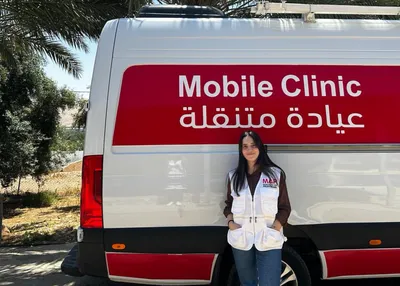
This psychological toll takes another form for MAP's own mobile clinic staff, delivering healthcare to hard-to-reach areas and communities cut off from care.
In late July, a MAP mobile clinic team was midway through its weekly clinic visit in the town of Beit Furik, near Nablus, when the checkpoint sealing the town's only entrance shut without warning, trapping them inside with no way of knowing whether the gate would reopen in hours, or days.
Days after the incident, the unease our team experienced hadn't settled – a reminder of how these attacks and obstructions are used as psychological warfare to displace Palestinians from their homeland.
For many, the closures and settler violence don't just delay access to life-saving care, they make staying in their lands and homes impossible. Since 1 January 2025, more than 40,900 Palestinians have been forcibly displaced across the West Bank. This is the largest displacement crisis in the West Bank since Israel began its occupation in 1967.
This year, settler attacks have become the number one cause for this displacement.
MAP continues to respond: supplying hospitals in the north with medical equipment and supplies, equipping PRCS emergency teams, training communities in first aid, and running mobile clinics in areas that would otherwise have no access to healthcare.
None of this replaces what is actually needed: an end to the violence, and to the impunity that allows it to continue.
Please pay attention to what is happening. The right to health is being systematically undermined, and the consequences for people's lives will only become more severe if the world continues to look away.
Nurse from Beit Furik
Related content