“Classified as refugees within our own homeland.” - 78 years of ongoing Nakba
24 June 2026

This year marks 78 years on from the Nakba in 1948. In this series, MAP colleagues from Gaza, the West Bank, Lebanon, and the UK share what it means to carry this catastrophe, not only as legacy, but as lived reality.
We continue in the West Bank with Marwan, who shares his family's displacement from Jaffa.
Both of Marwan's parents were classified as refugees within their own homeland. The end of the British Mandate and the establishment of Israel in 1948 erased the legal identity that had defined them as Palestinians. Their homeland had been taken away from where they stood.
Like millions of Palestinians scattered across the diaspora, his family was left navigating between worlds. Between the loss of what was taken, and the effort to build a future from it.
“One of the last cities to fall”
My grandfather, Mikhael, was a dentist in Jaffa. He had built a life there, a respected profession, a home, a future. Even before 1948, loss had already entered our family. His brother, Issa, was killed in the King David Hotel bombing in 1946 by Irgun, a Zionist militia. He was still a young man when he was killed. One of many. His death stayed with my grandfather and deepened his sense of belonging to this land.
My father, Emile, and his two brothers were young men at the time. They completed their secondary education in Jaffa at a college, getting what was then known as the London Matriculation certificate. They also held Palestinian passports issued under the British Mandate, officially bearing the name Palestine.

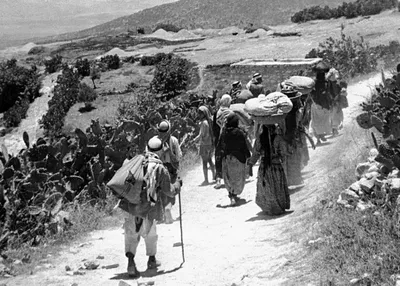
In 1948, after numerous massacres by Zionist militias, fear spread widely among nearby Palestinians cities of Jaffa, Ramla, and Lyd, and tens of thousands of families were forcibly displaced.
My grandfather’s brothers were among those who left by ship to Lebanon, but my grandfather arrived late. My grandmother and his children were waiting for him, but when they reached the port, they found huge crowds. They could not get on. They had no choice but to turn back.
People were clinging to the ship, hanging from it, packed tightly on top of one another.
Emile's description in the documentary, Al-Nakba: The Palestinian Catastrophe 1948 released in 1997.
The next day, they joined a convoy to Ramallah under British protection. From there, they moved again, this time to Zarqa in Jordan. Displacement did not happen all at once. It kept unfolding, step by step, place by place.
“A future that was taken from us"
In exile, my father and his brothers went to Alexandria in Egypt to continue their studies. For Palestinians, education was never just a choice—it was survival. It was dignity. It was a way to hold on to a future that had been taken from us. They became a doctor, a pharmacist, and a dentist. They rebuilt their lives, but never replaced what was lost.
Our family settled in Ramallah, where my grandfather opened a clinic. My father later opened his own pharmacy. Life continued—but the memory of Jaffa always lay just beneath the surface.

In 1968, we made our first trip back to Jaffa because we still had relatives there. My grandfather insisted on going to our house at King George Street, and he did. There they found someone else living in our home, an Israeli originally from Bulgaria. He was a dentist, by coincidence.
On the way back, my grandfather Dr Mikhael suffered a stroke. They took him to hospital, but he passed away that same day as a result of that shock, of that overwhelming sense of loss.
I believe he died from grief, not from anything else. Like millions of Palestinians. We are not alone in that.
Marwan, on his grandfather's death
When my family were displaced, they lived in a refugee camp, but never registered for a refugee card. We have a saying: “the people of Jaffa left the radio on in Jaffa,” meaning they thought they would come back and simply turn it off. They could never have imagined, that 78 years later, the Nakba and the displacement of our people would still be ongoing.
That is the story of displacement and the Nakba, which I believe continues to this day in different forms. This is not just history. It is our present.
Related content